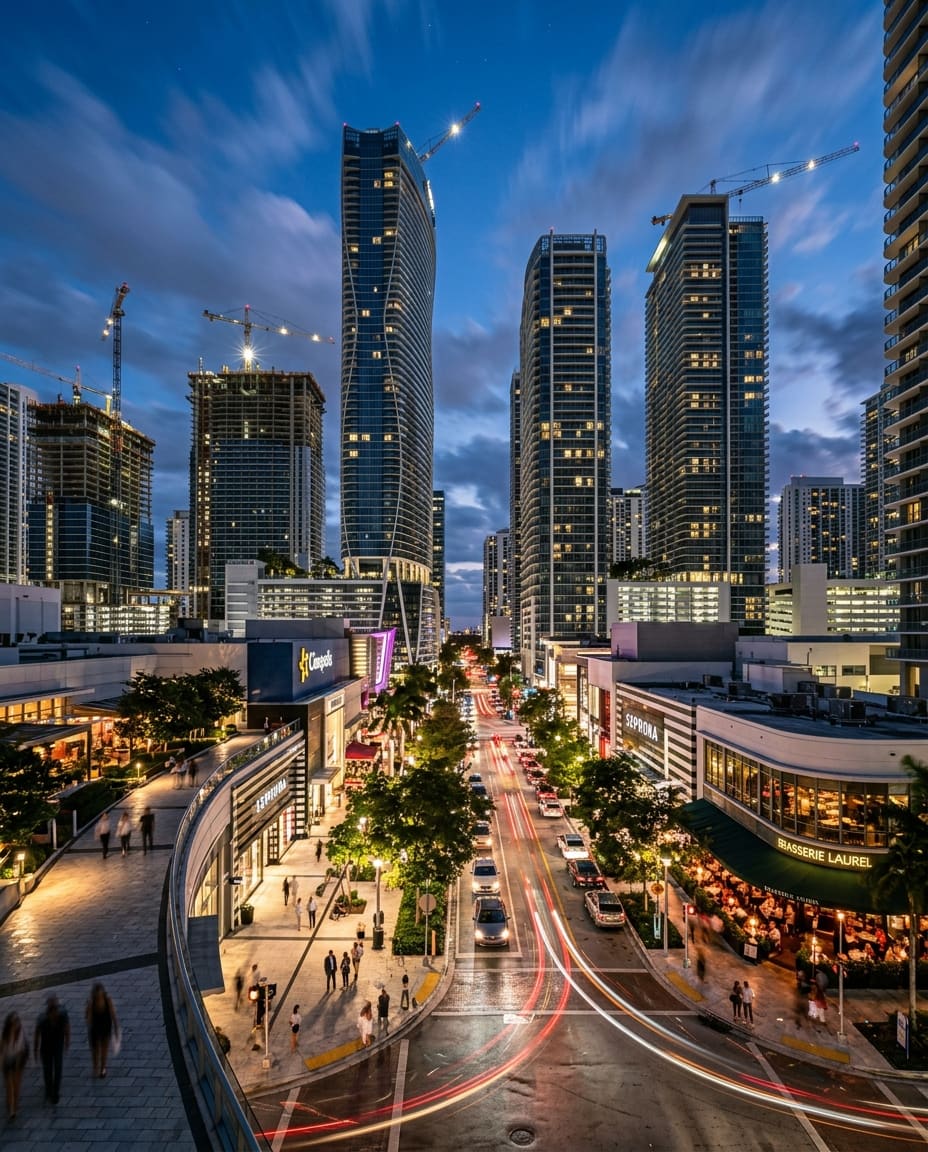
Miami, a metropolis that beats to the rhythm of innovation and dynamism, is undergoing an unprecedented urban transformation. At the epicenter of this renaissance is Downtown Miami and, prominently, the Miami Worldcenter—a 27-acre megaproject that redefines the concept of luxury urban living. As we approach 2026, the city's silhouette continues to evolve with impressive cadence, revealing a series of developments that not only promise to alter the skyline but also to enrich the social and economic fabric of South Florida. This deep dive explores the scope and magnitude of the projects now emerging, those that are cementing Miami's reputation as a true global hub.
A Horizon of Urban Transformation: Miami Worldcenter as the Epicenter
The $4 billion Miami Worldcenter represents a bold vision for a mixed-use district that seamlessly integrates retail, dining, entertainment, hotels, offices, and residences. Its concept includes the creation of a ten-block "High Street," serving as a vibrant commercial and social axis. While some of its phases will extend beyond 2026 and 2027, the year 2026 is shaping up to be a crucial period for the delivery of numerous projects currently under construction or about to break ground. This development stands as a primary catalyst in the metamorphosis of Downtown Miami, which is transitioning from a traditional business district to a vibrant, 24/7 urban enclave where life, work, and leisure converge.
To grasp the scale of what is to come, it is essential to recognize the foundations already laid. Iconic towers like Paramount Miami Worldcenter, delivered in 2019 with its 60 floors and 569 residences, have already set a standard for luxury and exceptional amenities, including a five-acre deck with a private golf simulator, boxing ring, and a wellness spa. Likewise, approximately 300,000 square feet of retail space in the "Jewel Box Retail" is already operational, infusing life and activity into the streets. These initial milestones are but a prelude to an explosion of development that will continue to redefine the urban experience in the heart of Miami.
The Architecture of Tomorrow: Projects Defining 2026
Miami's skyline is rapidly filling with projects that encapsulate the vision of a sophisticated urban life tailored to contemporary needs. The year 2026 is emerging as a significant turning point, with the completion of various residential and hotel towers that will not only increase Downtown's population density but also enrich its offering of services and experiences.
Flexible and Luxury Residences: The New Generation of Housing
Among the residential developments slated for delivery in 2026, projects that capitalize on the growing demand for market flexibility stand out. The Crosby Miami Worldcenter, a collaboration between Related Group and Merrimac Ventures, currently under construction with completion expected in the first quarter of 2026, will offer 450 luxury residences. Its design is particularly notable for its focus on flexibility for short-term rentals, with no restrictions, and for offering fully furnished, "turnkey" units. With prices starting at $500,000 and units ranging from studios to two-bedrooms (approximately 350-825 sq. ft.), The Crosby caters to a market segment seeking both investment and convenience.
In the same vein, 600 Miami Worldcenter, developed by Aria Development Group and Merrimac Ventures, is also under construction and expected to be ready in 2026. This 32-story tower will house 606 fully furnished residences, similarly designed for unrestricted short-term rentals, with management by Nomada Residences. Its starting prices are in the low $400,000s, offering studios and two-bedroom units, which broadens accessibility to this flexible living model.
Another landmark project is E11even Residences Miami, with its phases 1 and 2. The first phase (E11even Residences Beyond) topped out in early 2024 and is expected to be completed by late 2024 or early 2025, followed closely by Phase 2. Developed by PMG and E11even Partners, these luxury residences are intrinsically linked to a concept of integrated nightlife and hotel amenities, promoting a "24/7 lifestyle." The units, also designed for short-term rentals, began sales from the $300,000s, with penthouses reaching considerably higher prices, reflecting their exclusivity and the appeal of their unique proposition.
Convergence of Wellness and Hospitality: Redefining Urban Luxury
The trend toward integrating wellness and hospitality into the residential environment is spectacularly realized in projects like Legacy Hotel & Residences at Miami Worldcenter. This 50-story tower, developed by Royal Palm Companies, topped out in early 2024 and is expected to be completed by late 2024 or early 2025. It will include 310 hotel rooms and 278 branded residences, distinguished by housing Downtown Miami's first comprehensive health and wellness center, with a 50,000-square-foot medical and wellness facility, plus a one-acre urban resort-style pool. The residences started sales in the high $300,000s, attracting those who seek a lifestyle that prioritizes health and luxury. In parallel, the Hyatt Centric Hotel, also under construction, is projected for completion in 2026, adding a significant hotel offering and strengthening the district's tourism and business infrastructure.
Elevating the Horizon: Landmark Projects with a Long-Term Vision
Beyond 2026, and often already influencing current market perception, are projects of monumental scale that not only redefine Miami's skyline but also solidify its status as a global destination for luxury and sophistication. These towers, although with delivery dates extending beyond the immediate horizon, are intrinsic to the growth and development narrative of Miami Worldcenter and Downtown Miami as a whole.
Iconic Silhouettes and Global Prestige
The Waldorf Astoria Residences Miami, which began construction in late 2022 and is expected to be completed in 2027, is set to be one of the tallest residential skyscrapers south of New York City, at 1,049 feet and 100 stories. This development will include 360 luxury residences and 205 hotel rooms, with prices ranging from $1 million to over $50 million, firmly positioning it in the ultra-luxury segment. Ryan Shear, Managing Partner of PMG, one of the developers alongside Greybrook Realty Partners, has stated, "This is a one-of-a-kind development that will forever transform the Miami skyline." This statement underscores the magnitude and lasting impact expected from this iconic project.
"This is a one-of-a-kind development that will forever transform the Miami skyline." - Ryan Shear, PMG Managing Partner
Meanwhile, the Delano Residences Miami Worldcenter, with sales launched in mid-2023 and construction expected to begin in late 2024 or early 2025 for a 2027/2028 completion, promises to introduce the Delano brand to the residential sphere. This 985-foot tower will house 644 luxury residences, designed with notable flexibility for short-term rentals and managed by Accor's Ennismore. Amenities will include an exclusive Delano Beach Club, wellness facilities, and a premier dining offering. With prices starting in the $700,000s, these residences are designed to attract a market that values both luxury and versatility. Nitin Motwani, Managing Partner of Merrimac Ventures, a co-developer with Aria Development Group, has noted that "the demand for luxury, short-term rental-friendly properties in Miami remains incredibly strong, and we believe Delano Residences Miami Worldcenter will set a new benchmark."
"The demand for luxury, short-term rental-friendly properties in Miami remains incredibly strong, and we believe Delano Residences Miami Worldcenter will set a new benchmark." - Nitin Motwani, Managing Partner of Merrimac Ventures
In addition to these titans, other projects like the CitizenM hotel (already open), LIV Lofts, and Motley Miami Worldcenter (a 40-story residential tower) continue to add to the density and diversity of offerings at Miami Worldcenter, cementing its status as an epicenter of constant activity.
Economic Pulse and Market Dynamics: The Influx of Capital into Downtown Miami
The scale and pace of development in Downtown Miami and Miami Worldcenter are not mere architectural phenomena; they are tangible manifestations of robust economic and market dynamics. This growth is a magnet for capital, attracting both institutional investors and individual buyers, reflecting unwavering confidence in Miami's long-term potential.
Miami Worldcenter is, in essence, a monumental growth engine. Its development is driving the creation of thousands of jobs in construction and, once operational, in the retail, hospitality, and service sectors. This injection of employment contributes to a more vibrant and resilient local economy. The integration of retail, dining, and entertainment components, along with increased residential density, is generating a notable increase in foot traffic in Downtown, which in turn boosts local businesses and fosters a more dynamic urban environment.
Population influx is another crucial factor. The significant volume of new residential units is designed to meet Miami's remarkable demographic growth, fueled by both domestic migration within the United States and its international appeal. This diversification through a mix of residential, hotel, office, and retail uses reduces reliance on a single sector, making the Downtown economy inherently more resilient to fluctuations. Furthermore, the emergence of super-luxury towers, like Waldorf Astoria and Delano, elevates Downtown's profile in the high-end segment, attracting high-net-worth individuals and solidifying Miami's position as a global luxury destination.
The impact on property values in the Downtown Miami corridor is profound. The scale and quality of development at Miami Worldcenter act as a primary driver of appreciation for surrounding properties. A "Worldcenter Effect" is observed, where properties within and adjacent to the Worldcenter command a premium due to access to new amenities, walkability, and associated prestige. This effect radiates to nearby areas like Brickell, Edgewater, and adjacent parts of Overtown as infrastructure improves and desirability increases.
Strong rental demand, for both long- and short-term, especially within Worldcenter, supports robust rental yields, which in turn underpins property values. Although there is a considerable project pipeline, population growth and Miami's appeal often outpace new supply, particularly for well-located and amenitized units, maintaining upward pressure on values. The resilience of the luxury market, evidenced by sales of high-end residences, suggests less sensitivity to economic fluctuations at the upper echelon of the market.
21st Century Cosmopolitan Life: Amenities and Lifestyle Trends
The development of Downtown Miami is not just about brick and mortar; it is the creation of a complete urban ecosystem that caters to a modern and demanding lifestyle. Current trends in new construction reflect a deep understanding of what residents and visitors seek in a global city.
Dominance of Short-Term Rentals (STR)
One of the most prominent trends is the proliferation of developments explicitly designed for short-term rental flexibility with no restrictions. Projects like The Crosby, 600 Miami Worldcenter, Delano Residences, and E11even Residences are examples of this market strategy. This is a response to strong demand from investors seeking passive income and from tourists or business travelers who prefer apartment-style accommodations. The management of these properties by renowned hotel brands or specialized rental management companies (like Nomada or Accor's Ennismore) ensures seamless guest experiences and professional property maintenance. Miami consistently ranks among the top cities for Airbnb/short-term rental occupancy and revenue per available unit, making it an attractive market for this type of investment.
Innovation in New Developments
The 2026 horizon promises a continued influx of high-rise residential and mixed-use projects. A key focus is the offering of "turnkey" and "fully furnished" units, aimed at attracting a wide range of buyers, including international and domestic investors. The integration of advanced technology and "smart home" features is standard in most new constructions, providing convenience and efficiency for occupants.
Exceptional Lifestyle Amenities
New constructions in Downtown Miami and Miami Worldcenter are raising the standard for amenities, offering an unparalleled lifestyle:
- Wellness and Health: A fundamental trend. Legacy Hotel & Residences, for example, features a comprehensive health and wellness center. Many towers include state-of-the-art gyms, luxurious spas, and even meditation rooms, responding to a growing consciousness about holistic health.
- Resort-Style Pools: Large amenity decks with expansive pools, private cabanas, and food and beverage service are common, as seen at Paramount and Legacy, creating urban oases for relaxation.
- Dining and Entertainment: The Worldcenter retail promenade is attracting a diverse mix of restaurants and entertainment venues. Projects like E11even Residences integrate nightlife directly into their offering, providing immersive experiences.
- Flexible Workspaces: In response to evolving work patterns, co-working spaces, private meeting rooms, and high-speed internet infrastructure are standard features, facilitating remote and collaborative work.
- Concierge Services: High-end developments offer extensive services, from valet parking to personalized concierge assistance, elevating the living experience to the highest level.
- Walkability: The Miami Worldcenter master plan emphasizes pedestrian-friendly streets, public plazas, and direct access to public transit (Metromover), fostering an active and connected lifestyle.
Looking Forward: The Future of a Global Epicenter
The year 2026 is not just a date on the calendar for Downtown Miami and Miami Worldcenter; it is a crucial stage in a much broader transformation narrative. The projects being built and those on the verge of materializing are not mere additions to the real estate inventory; they are fundamental pieces in cementing Miami as a top-tier global city—a melting pot of cultures, commerce, and cutting-edge lifestyle.
Art Falcone, Managing Principal of Miami Worldcenter Associates, encapsulates the essence of this moment: "Miami Worldcenter is rapidly coming to life, attracting residents, businesses, and visitors to a dynamic urban core. The ongoing construction and new project announcements underscore the vision we have always had for this transformative development." This vision is shared by industry leaders like Jorge Pérez, Chairman and CEO of Related Group, who has noted that "Downtown Miami is evolving into a truly walkable and cosmopolitan hub, and projects like The Crosby are essential to meeting the demand for modern, flexible living options."
"Miami Worldcenter is rapidly coming to life, attracting residents, businesses, and visitors to a dynamic urban core. The ongoing construction and new project announcements underscore the vision we have always had for this transformative development." - Art Falcone, Managing Principal of Miami Worldcenter Associates
The combination of robust infrastructure, a steady flow of investment, a demographic boom, and an unparalleled offering of amenities and services positions Downtown Miami not just as a center of growth, but as a model of sustainable and vibrant urban development. The challenges inherent in such rapid growth, such as traffic management and preserving local character, are opportunities for innovation and strategic planning.
The future of Downtown Miami and Miami Worldcenter is one of continuous evolution and consolidation. As towers rise and communities flourish, the city is redefining not only its physical skyline but also its cultural and economic identity. The year 2026 will mark a benchmark in this journey, revealing a district that is, more than ever, a testament to Miami's ambition and innovative spirit—a global epicenter that continues to astonish and attract the entire world.
Exclusive Property Insights